I stood at my bedroom window. The rising wind had drawn me to the glass pane. Was a rain storm arriving before I had a chance to put the garbage out? No, it was just a random gust of wind, swirling the already fallen small yellow leaves from the shad that guards the front door. I paused to watch the leaves dance across the damp grey of the driveway and into the side yard where the faded brown grass of summer was greening up from early September rain. Autumn will be here too soon. The thought of raking the leaves from the shad and the poplar and the white birch had me turning away from the window, reluctant to see more work piling up on the lawn.
Another gust, but with a different tone, had me turning back. It was not the wind that had made the noise, though branches were swaying in the brisk breeze. It was the swirling, glistening black of a flock of starlings that I heard before I saw. They swept in from the south, across the broad front lawn, not as a wave, but as a tornado of wings, twirling up, then down, to the right and then to the left. Grazing the lawn then rising again only to return in a variation of their first descent. There were dozens, maybe a hundred birds, a few on the front lawn but most to the left of the driveway, gathered under the black cherry tree. It seems the wind had shaken loose some of the small garnet fruit from the tree, a favorite of birds and chipmunks every autumn.
A sharp noise caused my eyes to swerve from the mass on the lawn. Just a few feet away from me, an industrious individual had landed in the gutter and was busily digging through the gathering debris. His orange beak poked into the damp leaves and browning pine needles, knocking them onto the roof and the ground below. Occasionally, his onyx eye found a treat. Up his purple-hued head would tilt as he swallowed his treasured tidbit. His feathers had the shimmer of amethyst and teal amidst the black, like the swirls of color oil makes in a rain puddle; iridescent and rich against the black. Orange legs supported his hopping gait as he moved along the length of the gutter in his solitary search for food.
Two of his fellows landed near him but without his industry, or optimism, they quickly flew away to join the others on the ground, digging in the leaves and grass for the few cherries that had been knocked to the ground by the wind.
The starling turned to look at my window. His head cocked at a quizzical angle, he hopped up the small slant of the garage roof towards me. Three hops, then a pause. Then two more and he stopped. One more foray brought him right below me, less than a foot away. He waited there for a moment, tilting his head once to the left, then to the right. He glanced back down at the flock beneath him. Then he looked me right in the eye as if to say “I am a solitary soul. They must travel together, safety in numbers, but I find the richer rewards by going my own way. Still, there are times when I wish I could be part of the whole. There are times when I fly among them. And, there are times when I must lead.”
He turned and flew straight away, above the trees. The flock paused, a few rising. Then they swirled into the sky and were gone.
The Starling
Labor Day
It isn’t about a big sale, or what to barbeque for friends and family or even that after today some of us will not wear, or will feel distinctly uncomfortable wearing, white shoes, slacks or skirts and carrying a white purse. All day I have wanted to shout: It’s about workers.
I haven’t seen an historical reference to the origin of the day on any of the news programs or baseball games I watched today. At shul this morning, there was a passing reference to veterans, and I’m not sure where that came from. On Facebook, unlike Memorial Day or Veteran’s Day, there has been no commentary about the day, why it is a National holiday, who is being honored. There are no parades that I have seen scheduled for today.
This year is not unlike other years. But this year, I seem much more sensitive to the meaning of the day than ever before.
I have spent my entire professional career as a labor law neutral. For 34 years, I have heard and decided cases or defended decisions involving public sector employees. Teachers, fire fighters, police officers, prison guards, lawyers, heavy motor equipment operators, corrections officers, secretaries, metal health therapy aides, custodians, bus drivers and laborers, their unions and their employers have found their way before me. Today is about them.
It is also about coal miners, textile workers, automobile assemblers, farm workers, retail sales associates, nurses and teamsters, longshoremen and railway employees. There are millions of employees in this country and this holiday is about them. And the ones who came before them.
And this year it seems important to remember that. In the midst of all the campaign rhetoric about business and how America needs to support its businesses to create more jobs, I keep thinking about the days when our government was all about business. When the business of America was business. The time when the workweek was six or seven days long (depending on how Christian your boss was and whether he would dare the wrath of his fellow believers to keep his factory open on the Sabbath) and the workday was 10 or 12 hours. When the average worker made pennies a day. When the average worker was a woman, or young girl or little boy, as well as men of any age, but not any color, at least not in the North. When the workplace was a tenement, or a basement, or a shack or a factory with boarded up windows so you wouldn’t be distracted by sunlight or fresh air. Or a mine with no ventilation and no light except the candles held by little boys. When there were no coffee breaks, lunch breaks, dinner breaks or bathroom breaks. And when you were sick or injured because of the job, you were fired. When you lived in your employer’s housing, shopped at his store and your wages were never quite enough to pay what you owed him at the end of the week or month or year.
I look at the places that now have American jobs: Malaysia, Singapore, Sri Lanka, Pakistan, Mexico and Haiti. And I see the same thing: children being sold into slavery to pay debts, women and men working in filthy, crowded conditions for a small fraction of what their work is worth, grateful for few cents or dollars they make because it will mean some food or some shelter for their families. And they work for American companies, producing goods sold in America, goods that used to be made here. American companies who don’t invest the profits in America any more. They dismantle American plants and businesses, in the name of profit, and invest the money in Switzerland or the Grand Caymans. And they don’t pay taxes on those investments either.
This is not about the farm stand on the corner, although the plight of the migrant farm worker is little better now than it was a century ago. It is not about the independent bookstore or the local builder or the mom and pop ice cream stand. Those businesses use local materials, hire local workers and invest their profits back into the community. It isn’t even about the huge American corporations that have kept their business in America and who employ thousands of Americans, unionized Americans.
Labor Day is about paying employees a living wage. It’s about safe working conditions. It’s about a reasonable workday and work week. It’s about making a profit but not at the expense of employees’ health or lives. It’s about children being in school and not in mines or lettuce fields. It’s about the people who died in the Haymarket Riots, the Pullman Strike and the Triangle Shirtwaist Factory fire. It’s about men and women who came together to say “we shouldn’t have to starve or die to get a job.”
And if you think that would not still be the case without organized labor, then look at the working conditions in South America, Africa and the Far East. I wonder if companies would ship jobs overseas if they could have the work performed here in America for the same price. And what is keeping them from doing so? Fair labor laws enacted at a time when the government realized that continuing laissez faire business practices at the cost of human lives was inhuman. And who made that argument? Organized labor.
So, today, while you are eating barbeque with friends and family or shopping a Labor Day sale (being waited on by someone who makes minimum wage with no benefits and doesn’t have this national holiday off), think of what the holiday means. And think about what your job or the jobs of your family or friends might be like if there were no labor laws in America and companies were not regulated and employers could act with impunity towards employees. And say thank you to the American worker.
August 26, 1978
Nuns. I kept seeing nuns. It was my wedding day and I was feeling like Maria in “The Sound of Music.” But, I wasn’t wearing a wedding gown yet. I was in a simple dress and it was 7:15 in the morning, in the convent chapel in Malone with my mom, my sister, Cindy DesParois and Pattie McEnroe and maybe Connie Gibbons, but I don’t think so. We were going to Mass. Marrying a Jewish guy precluded me from having a wedding in Notre Dame Church, even though I was having a priest, a rabbi and a minister officiate at my ceremony later that day. Father Giroux (so handsome that we privately called him Father What-a-Waste) suggested I come to Mass that morning with the nuns.
“My mom wants me to take Communion,” I muttered to him the week before as Mitch and I finished our last Pre-Cana Conference.
“You can take Communion.”
“I haven’t been to confession in at least five years,” I stated, somewhat defiantly.
“Have you murdered anyone lately? No?” He smiled as I shook my head.
“Then I’ll give you Communion. God won’t care. You are doing it for your mother.”
No way for me to get out of it. Mitchell’s smug little smirk that let me know he would be sleeping in until our rehearsal later in the morning had me contemplating no end of venial sins I could commit at his expense.
As an honor, the nuns let me sit in the first pew. They could be magnanimous, I was only marrying a man, they were Brides of Christ. And I had to be first in line for Communion. Father Giroux laid the host on my tongue then we both glanced Heavenward at the same instant to make sure that the roof was not going to be sent down upon our heads for this sacrilege.
The Country Club provided another potential disaster a few hours later. We were supposed to be married on the patio, overlooking Owl’s Head. The staff had removed all the chairs and umbrella tables to clear the way for us. However, there were pipes sticking up out of the concrete all over the patio, revealed as soon as the table umbrellas had been removed. Flowers, chairs, and the traditional Jewish wedding canopy, the chuppah, all sat waiting our decision. We couldn’t use the patio; people would be tripping and falling all over with those damn pipes.
“Move over onto that lawn.” My father, a problem solver but no golfer, pointed to the putting green. The Club manager paled at the thought of multiple high heels poking holes in the pristine grass surface, but he reluctantly agreed. Problem solved, we sat down to lunch and laugh with friends and family.
A quick trip to the hairdresser for a wash and dry of my poodle cut (I still cringe at pictures of that popular do…what was I thinking), a fast manicure in pale mauve by my soon-to-be sister-in-law, Margot, a bubble bath and I was on my way back to the Country Club in Cindy’s car. We had commandeered the Ladies Locker Room.
Insanity. Seven women plus me. Two matrons of honor (my mother made me pick my sister and my college roommate, Susie, had beaten me to the altar), five bridesmaids and the bride, trying to get dressed in a locker room and lounge. Someone took a photo of me in my white lace bra and panties, leaning way over a sink, my nose almost pressed against the mirror, applying coat after coat of mascara. In the corner of the lounge, Connie and Leslie Kriff were arguing with my sister-in-law Margot about the floral hairpiece she was supposed to wear. Cindy was trying to find us some glasses of champagne; she did manage to score some innocuous white wine to calm our nerves. And from the window, I heard the voices of the Rabbi and the Priest arguing about whether the name of Jesus Christ could be mentioned during the ceremony. Mediating that battle was Irv, Mitch’s roommate from his VISTA volunteer days, a final year Yale Divinity student.
We had photos taken all over the Country Club and immediate grounds before the guests arrived, despite my Aunt Gaye’s predictions that since it was bad luck for the groom to see the bride before the wedding, our marriage would probably not last. But, I wanted those photos while there was still daylight and I needed Mitch.
Tall, dark and handsome in his navy blue tuxedo, a small smile revealed under his bushy moustache, his hand firmly holding mine, he was everything I wanted. Knowing I was not altogether pleased with my dotted swiss wedding gown (my mother cried when I tried it on, what else was I to do but buy it), he told me I was breath-taking. And I believed him.
The ceremony was scheduled for 7:00 p.m., enough after sundown to satisfy our Rabbi-for-Rent. Our guests gathered around the chuppah. The sky was a tangle of pink, purple and blue clouds with a few weak rays of sunshine piercing the impending dark (my mother had hung a dozen rosaries on her clothesline all day to keep the predicted rain away). My two oldest nephews, Craig and Marc, handed out programs to the mixed faith crowd of Jews, Catholics, Protestants and one Buddhist. This was to be an event unlike any they had seen before. We had designed the ceremony and written our own vows. “Obey” was not a word that either of us was comfortable with. Aunt Gaye commented after the ceremony that we probably were not legally married because our vows did not have the required language.
Mitch’s parents walked him out, and then I was escorted by my mom and dad, to the strains of “Color my World” by Chicago, played by my brother Jon’s girlfriend, Jenny, on flute and our law school friend, Nelson, on guitar.
Irv was to open the service with a prayer. He stepped forward, all Episcopalian, in his grey robe and white collar and intoned, “In the name of Moses our Father and Jesus, our Brother….”
I gasped, Mitchell snickered, Rabbi Roth frowned and Father Giroux rolled his eyes. It was all uphill from there.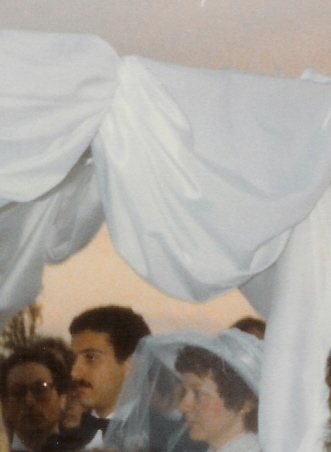
The reception, it was agreed by all, was the best party Malone had ever seen. The misplaced challah was retrieved from my mom’s house thanks to a quick trip by Brother Bob, but we forgot to put out the favors: matchbooks with our names on them (I still use them to light birthday and Hanukkah candles). Uncle Bill and Uncle Paul both passed out at some point. After my father and I danced to “Daddy’s Little Girl”, Margot taught the band to play “Hava Negila” so we could dance the Hora. Every song they played thereafter sounded like a combination of the two!
We broke with Malone tradition and did not open our gifts at the reception, but to appease my sister, around midnight, the wedding party and assorted friends and relatives congregated at my parents’ house to open presents. Seven pairs of candle stick holders in every material imaginable first brought appreciative comments, but by the time I opened up the box with the seventh set, in pewter, I think, we were all giggling out loud.
It was after two when Mitchell and I drove up to the View Motel to go to bed. Unfortunately, Mitchell had failed to confirm the reservation and our room had long since been given to someone else. It was Fair Week, so there were no vacancies anywhere. We hurried over to the Gateway Motel and to our great relief (and astonishment) there were some unused rooms amongst members of our wedding party and law school guests. It seems some had decided to “share” rooms that night in a spirit of good will, many drinks and wedding party congeniality.
While our friends and relatives were romantically involved, my frugal husband counted money and checks to make sure we had enough for our honeymoon and the florist’s bill, inflated at the last moment with all the pots of white mums that were necessary to direct the guests to the putting green and not the patio.
We collapsed into sleep just before dawn, husband and wife. But not Mr. and Mrs. Hallow. I had decided not to change my name and Mitch was fine with my decision. Not so our resident legal expert, Aunt Gaye, who had stated to me that morning that it was illegal to be married and not take your husband’s name. Two recent law school graduates who had decided that we couldn’t be married until after we took the Bar Exam in case one of us killed the other in a fit of panic and frustration. We got through that test and the blending of two faiths and two vastly different backgrounds at our wedding.
Yeah, we were SO married.
August 25, 1978
Stella Yando. It is not a name you hear every day, especially in Saratoga County. But, in Malone, in the 1970’s, it was a name to be reckoned with if you were having a party. And we were having a party.
It was the last Friday night of the Fair and looked to be very cold, down in the 50’s, maybe the 40’s. I had packed a sweatshirt or two before I left Albany a week earlier. Mitch had brought his ratty red hooded sweatshirt with him when he arrived the night before. We made a quick run down to the Fair on Thursday night to get some fried dough with maple cream and walnuts for my mom and grab a ride on the Ferris Wheel. The sky was cloudy, no stars were visible, even from the top of the wheel, but Malone spread out below us, small sparkling lights hidden in dark green, except for the well-lit, long asphalt strip that was Main Street (aka Route 11). We kissed at the top, we hadn’t seen each other in five days, and there would be no intimacy until Saturday night.
I had been cooking and cleaning for days at my parents’ house. The rehearsal dinner would be there on Friday night, even though the rehearsal was not to be until Saturday morning, at the Country Club. It would be my in-law’s first visit to Malone, a long drive and light years from Long Island. My brothers lived in Malone, two at my parents’ house. My sister lived nearby, but spent almost every waking moment at Mom and Dad’s. Most of the wedding party was from out of town, one of my matrons of honor, her husband, Mitch’s sister, and another bridesmaid were flying in that night to Montreal. I had serious misgivings about their ability to navigate the road from Dorval Airport to Malone. Brother Bob was enlisted to go find them if things went awry.
Friday morning was busy. Mom was making pies. I still had cheesecakes and macaroni and cheese to make. Mitch had to pick up his tuxedo at the Bridal Shoppe on Main Street, but first I put him to changing the linens on the beds in Jon’s and Bob’s rooms, in preparation for the arrival of assorted cousins and second cousins from Philadelphia. Mitch would be staying at the Gateway Motel with his mom, dad and sister. Bob, Jon and Billy would be bunking in the studio apartment attached to the garage.
My mom and I had lists and more lists of tasks, errands, recipes and menus. We would not have enough time to do everything ourselves. She wrapped her arthritic fingers around the arm of Mitchell, probably her second most favorite person in the world.
“Mitchell, I need you to run an errand.”
“Okay, Peg, anything for you.”
“I need you to drive out the Brainardsville Road to Stella Yando’s house and pick up the baked beans.”
He would have gone anywhere for my mother. The baked beans were just an added incentive; the man loved baked beans.
Off Mitch and Brother Bob went. I was mildly concerned about how long it would take; Brother Bob was known to wander off-course, sometimes to visit Cookie or Scott, sometimes to stop at the Snowy Owl for a beer. It took some time for them to return, a huge covered tray in Mitch’s hands, a huger smile lighting his handsome face. The sweet, spicy fragrance of the beans preceded them. We smelled them before we saw them.
We could tell they had already sampled Mrs. Yando’s prized recipe. Mitchell started singing: “Stella, Stella Yando, Queen of the Baked Bean Trail!” He giggled, Bob laughed.
Through the hectic hours of the afternoon and early evening, the arrival of friends and family, the dishing up, slicing and pouring, I would catch Mitchell, humming or singing his new tribute ballad.
The party was a success, a trip to the Fair after 10:00 got me a huge stuffed animal won by Henry, our law school friend, more fried dough and kisses on the carousel. The NYC travelers had yet to arrive when I went upstairs after 2:00 a.m. to sleep alone for the last time in my old bedroom.
But, Mitch saw them driving down Main Street as he headed up to the motel. He followed them back to my parents and served them the leftovers from the party, before he sheparded them back up Main Street to the Gateway. Blissfully unaware that there was a second party going on in the kitchen, I slept until 6:30 when my mom awakened me to go to 7:30 a.m. Mass at the Convent.
Later, after our rehearsal, during lunch at the Country Club, Jeff, my matron of honor’s husband, told me that they had gotten lost near someplace called Rouse’s Point and had almost turned around and gone back to Montreal.
“I’m glad we didn’t, though, for your sake. But, mostly because last night Mitch gave us these unbelievable baked beans!”
Mitch was grinning and then he began to softly sing,
“Stella, Stella Yando, Queen of the Baked Bean Trail.”
August 21
She was knitting baby clothes when the pains began. The painter was in the nursery, applying the final coat of paint. Her husband told her she was wrong, it was too early, but she insisted. Speeding down the highway, a cop pulled them over. One look at her prompted him to give them a police escort to the hospital in Brooklyn. A wheelchair was waiting for her when they pulled up to the Emergency Room entrance. It was 12:00 noon. Her doctor had been called but he was not at the hospital yet; he had car trouble. As a result, her baby was not born until 1:20 p.m.
As was the practice in those days, she had been anesthetized for the delivery. When she regained consciousness, her first question was not “How is my baby?” or “Did I have a boy or girl?”
She asked “Did the Yankees win?” A prophetic question on the birth day of Mitchell Laurence Hallow.
He became a huge Yankees fan. Named for a family member who had died in the war, he grew up in Brooklyn and on Long Island. Dark curly hair like his grandfather and mother, beautiful whiskey brown eyes and long, curly eyelashes, he had his paternal grandmother’s perfect nose and her husky build. Sweet-natured, witty, intelligent and a naturally athletic, he invariably stood for the hurt, weak, helpless and lost.
Self-effacing, graceful, and strong, he was the Scholar-Athlete and Good Sportsman in school. More Jewish in his ethnicity than his religious beliefs, he spent two years on a kibbutz in Israel and returned with a deep love of Judaism. He volunteered for VISTA, the domestic equivalent of the Peace Corps, in the year after college, to teach prison inmates how to read. A candidate for Law Review, he declined in order to focus on his studies and his part-time job. He continued his work at a small general practice in Mechanicville after graduation. He was a stalwart champion of the kids for whom he became law guardian and an understanding advocate for all who came to his office.
A good friend, great husband and unparalleled father, he was loved by all who knew him. Especially his children and me.
He would have been 60 years old today. When I called his mom this morning to wish her “Happy Birthday” on the birthday of her son, she reminisced about his early arrival. I then thanked her for the gift of him, the best gift in my life. She sighed softly and said,
“Well, you know, thank you for being such a great wife to him. You were the best gift he ever got.”
I had no words in reply. Just a lump in my throat.
Converse All-Stars
I went off to law school with a pair of low-cut blue suede Converse All-Stars. They were so cool and made me feel like an athlete. I wore them to my first game on Donnie Zee’s volleyball team. It was also my last game. I might have felt athletic but my feelings did not translate into actual prowess and Donnie kicked me off the team after a ball dropped at my feet. Short-lived was my career as a server.
Not so for Mitchell, my new-found lover. He actually was athletic. He had won not only the Scholar-Athlete Award at Woodmere Academy but the Good Sportsmanship Award as well. He was such a good sport that he did not outright laugh at my abrupt banishment to the sidelines; he merely snickered. He, too, wore Converse All-Stars as he ran back and forth on the varnished wood of the Law School Gym/Auditorium. But, he pointed out to me, his sneakers were not just Converse All-Stars, they were Chuck Taylor, red suede high-top All-Stars. They saw him through three years of volleyball and pick-up basketball games and into our marriage. He wore them on the courts at our first apartment complex in Watervliet, our townhouse in Mechanicville and finally, his cherished concrete driveway where he could take shot after shot into his own basketball hoop. He had installed it himself on a warm spring day, pouring too much concrete into a too-deep hole to anchor the pole upon which he fastened the backboard and hung the net. We all scratched our names into the concrete to memorialize one of his few successful home handyman efforts.
He wore the sneakers for only a short time after that. One of our cats, Merlin, the one his mother had given us, peed on the sneakers in a fit of pique after the birth of our son. The sneakers ended up in the trash and the cat at the vet. I still believe that it was the cat’s desecration of the red suede treasures that earned his demise, not the snarling and hissing at our newborn son.
No more high-tops for Mitchell. Until August 9, 1988.
He had just been transferred from Champlain Valley Physician’s Hospital to Ellis Hospital. He had traded his fancy, nylon-coated, rotating, compartmentalized bed in Plattsburgh for a regular hospital bed in the Neuro ICU in Schenectady. During my late-night consultation with his new doctors on August 8, they informed me that he would need a pair of high-top sneakers to wear in bed to keep his feet from flopping forward, shortening the muscles and tendons in his legs. I sent my father-in-law out to get them for me and he, unknowingly, chose white Converse All-Stars high-tops. I brought them to the hospital on August 9.
Mitch looked tired. I attributed it to the long journey the day before. But he smiled when I showed him the sneakers and mouthed the question “no red suede?”
“When you get out,” I promised him, with an answering smile.
He died before he could wear the sneakers.
When they brought me to him that last time, the first thing I noticed when I walked into the room where he lay silent and unmoving, was the stark white of the high-tops, sitting on a shelf near his bed.
I threw them in the trash.
Summer
I don’t do well in summer. Father’s Day usually starts my doldrums. My son was born on July 4, 1985. My husband broke his neck three years later on July 8, 1988 and died 32 days later on August 10, 1988. His birthday was August 21, and our wedding anniversary was August 26.
I don’t start coming out of my horrible mood until after Labor Day and then the Jewish holidays, followed by the regular holidays, all centering on family, pretty much kick my ass until New Year’s, which is a bitch to spend alone. Valentine’s Day, my birthday in April and Mother’s Day in May are not good either. I’d say my one really good month is March; I don’t tend to get into much trouble in March except on St. Patrick’s Day, when Jameson’s and Harp can put me in a tailspin.
But July and August are definitely the worst months. I can still remember what happened each day in 1988. On this day, his heart stopped, on that day, they opened up his lungs and so on and so on until August 10. Then it is the myriad memories of funerals, eulogies, family and friends, and sitting shiva, during the hot, dry days of August.
This summer is particularly difficult. During my daughter’s cleaning frenzy on Mother’s Day in my house, in my room, I came across the notes and letters that I wrote to my husband while I was staying with him in the hospital. I thought they were locked away in a box in the closet t that had not been opened in 24 years but I found them in my nightstand drawer wrapped in a poem eulogizing my husband, written by one of our dearest friends. I should have put them aside but having glanced at them, I knew I must read every one after my daughter left. That was a rough night but I did not put the notes away.
I don’t know what made me decide to write about those 32 days, to use the notes as the spine of the story of Mitch’s injury, hospitalization and death. Maybe it’s because next year will be 25 years since he died, two and a half times the number of years we were married. Maybe I need to finally face those memories and put them to rest. Maybe because I sometimes get a little crazy in the summer. Maybe it’s because I am a writer and you have to write what you know. And I know his story must be told.
So, today I am writing that 24 years ago I was fighting with the administrators at Albany Medical Center, the regional trauma center, about transferring my paralyzed husband from Plattsburgh to their hospital, to the neurologists and orthopedists who were waiting to treat him. AMC was putting me off with excuses about lack of nurses and lack of beds. I was tired and starting to lose hope but my husband had slept through the night and that was enough for me to write that I thought the end of our trials might be near.
What was I thinking?
Words -March 1986
The scariest word in the English language? Cancer. The most terrifying sentence in the English language? “You have cancer.”
The breath is knocked out of your lungs and your heart skips a beat, then settles back into a rythym that is forever changed. You are now a cancer victim. You pray you will be a cancer survivor. A vicious predator has broken into your body, your life and the lives of all you love.
The tears spring out of your eyes. You cry for the person you were and for the person you thought had more years than you could count. You cry from fear, from anger and from the awful sense of your own mortality.
There will be phone calls to loved ones breaking the news. You will be the strong one, mimicking the words of the doctor like a faithful dummy of a prophetic ventriloquist: “We caught it early. It’s the kind of cancer you want if you have to have cancer. There will likely be no chemo or radiation after surgery. We’ll monitor you every three months or six months or year. The survival rate is very good. You won’t be out of commission for long.”
Then you’ll listen to friends and family cry for you and for themselves. They are afraid for you, but they are afraid for themselves, too. A very small part of them is saying “Thank you, God, that it isn’t me.”
You will go to sleep that first night after hearing the diagnosis feeling more alone than you have ever felt in your life. If you are lucky, there will be someone who loves you lying next to you to hold you and comfort you, needing the holding and comforting almost as much as you do. Your old life is over. Your new life is up for grabs.
July 4
It was, to quote Fanny Brice, like pushing a grand piano through a transom window.
It was the hottest day of the summer, July 3, 1985, and the hottest night. I spent the day at the pool with my mom and my three year-old daughter. I knew somehow that it would be that night, even without the predictions of my then-sister who predicted that I was going to celebrate the Fourth with my own little firecracker, so I did not have fried chicken or carrot cake for supper, just a little rice. The cat my mother-in-law gave me jumped on my stomach around 9:00 p.m. while we were watching “Terms of Endearment” and that did it. I called Dr. Rosen after I had gone upstairs for a shower because I knew it would be at least 48 hours before I got another one. He said to go to the hospital around 5:00 a.m. Right. I snorted when I hung up the phone. It rang again 15 minutes later.
“I forgot who I was dealing with; go to the hospital now. I’ll meet you there. And thanks for ruining my Fourth of July.”
“Don’t cry to me; you said this wasn’t going to happen for another week!”
I went upstairs to kiss my daughter while my husband loaded up our ugly green station wagon. Of course, it would be the only time she had ever wet the bed. So there I was at 11:00 at night, changing pajamas and sheets, when my mother found me.
“Are you crazy? Why am I here? Go!” She grabbed my daughter and tucked her into my bed; my husband would find them snuggled together the next morning.
We pulled out of the driveway round 11:30, our suburban neighborhood so quiet that I almost heard the lights switch on and the blinds go up at our friend’s house across the street.
“We woke up Kim and Al.” My husband observed.
“I’m going to kill you,” I responded. I had just seen the gas gauge: empty. “You didn’t think to fill the car up on your way home from work? Everything will be closed tomorrow; it’s the Fourth of July!”
“We’ll make it, there’s always some in reserve.”
But gas was now the least of my worries as the first contraction ripped through me. Giving birth hurts like hell. But as soon as they put your newborn baby into your arms, you forget the pain. That’s a good thing or else you would kill that baby that almost killed you and never have another. The human race would have been over almost before it started. You don’t remember the pain until you are in labor again.
The first contraction bitch slaps you into the terrifying realization that you are going to get killed…again. My response was to clamp my knees together, push my feet against the dashboard and pant as we crossed the Twin Bridges. My husband nervously looked over at me, patted my knee and said, almost condescendingly, that it would be all right. It is a testament to the love I felt for him and my survival instinct not to kill the driver of a car speeding along the highway at 60 mph that I did not rip his right arm out of its socket. I am not a placid and uncomplaining woman when I am in labor.
A few moments past midnight, we careened into the ER parking lot at St. Peter’s. My husband, the putz, jumped out of the car, grabbed the overnight bag and headed for the brightly lit entrance. It was then that I noticed the full moon, hanging low in the hazy July night sky. Crazies will be out tonight. And I’m one of them. What was I thinking? I stumbled out of the passenger seat, and holding onto the car, made it to the front bumper before the mother of all contractions hit. I clutched the front fender and summoned the strength to call out the name of the savior I no longer believed in: Jesus H. Christ! It was enough to get my errant husband’s attention; he came back and almost carried me across the parking lot.
We snagged the last wheel chair at the ER entrance. The aging security guard laconically observed that a lot of pregnant women had been coming in that night. “Happens every time there’s a full moon or a holiday,” he said as he held the door for us.
Upstairs, it was a madhouse. I sat on the edge of the bed in one of those ever so attractive hospital gowns while my husband took photos and an innocent intern took my information.
“What makes you think you’re in labor?” My husband, seeing the gleam in my eyes, backed away from the bed.
“Hook me up to the monitor,” I said through gritted teeth.
He started to say something, but then he, too, saw my eyes. “Okay, let’s do that.”
“Yes, lets!”
Yeah, I was spiking through the peaks that were hitting about every 90 seconds or so. That was enough for Dr. Teenage Boy to get me set up with an IV and the monitor. Then they looked up the gown and nurses and interns went running. The next voice I heard was Dr. Rosen’s sardonic “I was right. Last one only took four hours. I knew you weren’t going to make it till morning.”
He had given me a lot of drugs during my pregnancy to stave off the effects of allergic bronchitis; I was still convinced my baby was going to born with two heads. His early arrival in my room heightened not relieved my anxiety. I clutched the front of his polo shirt. “Is this baby going to be okay?”
“Yes, everything is fine.”
“You’re here and in my room, not the delivery room” I shot back accusingly.
“You were eight centimeters when they called me. Didn’t they tell you?”
No, they hadn’t. But, Dr. Rosen started yelling at everyone and I was soon whisked into delivery, while he and my husband went off to don scrubs. By the time the nurses had me on the table, the two most important men in my life were back, in matching green cotton pajamas.
No drugs. That is what I had decided for my first baby and, the pain forgotten for over three years, I had not planned on drugs this time either. Until the next contraction hit and didn’t stop. I begged my doctor for general anesthesia or at least morphine. Why is it that doctors laugh at you when you are in agony? His response was to tell my husband to hold my shoulders. Like that was going to help.
“If my legs were not strapped into these damn stirrups, I’d kick that smile right down your throat!”
The next two hours were spent in a tug of war between my son and my doctor. My plans for a peaceful, quiet delivery in a darkened room filled with the soothing strains of Mozart and Bach were completely upset by some mad woman screaming like a banshee to “get the damn thing out!” The labor was unrelenting; there were no lulls and no pauses, only continuous peaks. But, still no baby.
I was pushing so hard that I broke every blood vessel from my knees to my nose, and some in my eyes. Just after two o’clock in the morning, as I was pleading for a C-section, I saw a look pass between my doctor and my husband. A grim look followed by my husband’s hands slipping from the small of my back, to my shoulders, no longer supporting me but holding me down. Before I could snarl at him for the thousandth time, my doctor reached inside me and grasped my son by his shoulders, pulling him free. My eyes crossed as a scream and a baby were ripped from the very depths of me.
“It’s a boy!” The triumphant cry rang out. My husband was hugging me, laughing and crying at the same time. Nurses were bustling around me and I could feel my doctor’s busy hands, finishing up, making some repairs. But I couldn’t see my baby. I could hear the buzz of conversation and no one sounded alarmed but I couldn’t hear my son.
I couldn’t tell if I was shaking from fear or from the O+ factor, but the nurses tucked the blankets tightly around me, chin to ankles, to warm me and secure me. Dr. Rosen bent over me and whispered, “You did great and he is fine. Stop worrying, they’re just cleaning him up.” He squeezed my shoulder and smiled as my husband laid my son on my chest.
“Say hello to Benjamin.” His words were caught in his broad smile and tear-stained cheeks. “Say hello to our son.”
Masses of dark curly hair peeped out from under his little striped cap. Long dark lashes curled wetly on his cheeks. He was beautiful. Our little prince, heir to his father’s name and our mixed heritage. Our little firecracker, our own personal cause for celebration that July 4th and the 27 that followed thereafter. Hurrah!
The Pool
Dappled sunlight dances on the water. Random poplar leaves meander around the edges, swirling and then disappearing. Bubbles and gurgles near the steps, a quiet hum and whoosh near the door to the garage. My pool is open.
Twelve by thirty feet, with a two-foot bump for stairs, it sits nestled between the garage wall and the property line. Edged with overgrown forsythia poking through the chain link fence on the side, lilac and pine at the shallow end and shrubs separating it from the white siding of the house, it lies within a bower of green for five months of the year. The rest of the year it waits, shrouded in its black winter overcoat. Dry leaves dancing across its surface somehow, mysteriously, slipping under the near impenetrable seal, lie in murky darkness until May when the cover is stripped off revealing black musty water and green streaks on pale blue walls. That is when I hate the pool.
Days are spent dealing with wet leaves, dead frogs and even deader moles and mice, twigs and fetid water. Dollars wash away as the water level slowly rises, measured by clicks on the water meter, each click costing me dearly. Trips to Concord for sloshing containers of chlorine that leave white bleach stains on the carpet in my car and on the deck. Twenty-five pound bags of DE are swung one-handed by the pool guys into my car but heaved out in my two arms when I get home. Buckets of chlorine tablets that come individually wrapped and are so potent that you must hold your breath as you unwrap and drop each one into the chlorinator. I am overwhelmed by the pool.
Pool guys from Park or Concord who work quickly, but not efficiently, pulling the winter cover off , priming the pump, opening the valves and leaving a mess and often a malfunctioning skimmer or backwash in their wake. Then I step in to tinker and twitch the valves or the returns or the filter or all of them until the pressure is right, the water is moving and the motor is whirring. I am frustrated with the effort of doing the job I have paid someone else to do.
Finally, the yellow duckie floating thermometer is tied to the ladder, telling me that the water is a balmy 68 degrees. I wade in regardless, armed with my scrubbie glove, and rub down the steps. Then, holding onto the edge, I pull myself around the perimeter wiping away the last vestiges of winter’s dirty film from the pool border. Hauling chaises, floats and the market umbrella to shade me from the summer sun, I am almost done. The final touch is the two pink flamingos who nest next to the holly bush, their heads tilted quizzically toward the pool as if to ask, “When does the party start?”
Then my love affair with my pool begins. Days of floating in the crystal water, gazing at a blue sky through the overhanging green of birch and poplar and white pine. Evenings skinny-dipping under the black velvet sky and flickering lights from the stars and my neighbors’ upstairs windows, heavy humid air and warm water like a sauna surrounding me and easing my aches.
The pool was a labor of love from the start. Tired of schlepping the kids to the pool club several blocks away at Burning Bush, I had been whining about a pool for over a year. Finally, on July 8, 1988, I talked my husband into the pool of my dreams. An avid swimmer, he really wanted a pool but he could not envision one in our yard. The back yard had only a small open area, painstakingly planted with grass seed for three years by my husband. He finally had created a lawn, edged by over fifty poplar trees that surrounded our lot. He was loathe to give up that lawn.
“We don’t have to give up your lawn. We can put the pool on the side of the house, next to the garage.”
“No, we can’t, there isn’t enough room.”
“Yes, there is. Ten feet from the wall of the garage and ten feet from the property line, gives us twelve feet of pool width. I measured. From the front of the garage to the edge of the back deck is thirty feet. So that gives us a 12 foot by 30 foot pool. Enough to swim laps but no diving board.”
“I don’t want a diving board, too dangerous.”
“I agree. So can we do it?”
“If we get a home equity loan, and we can next year, yes, maybe.” He always hedged every concession with a “maybe”.
Fine with me, I had him convinced and I usually got what I wanted from him because I was careful not to ask for too much. Smiling and humming to myself, I drifted off to sleep while he completed the drive to Malone for a family reunion, his hand idly stroking my neck as he drove the last hour.
Eight hours later, he lay unconscious, covered with a white sheet on an Emergency Room gurney, his swim trunks cut up and thrown on the floor in a sodden mess. He had jumped into my sister’s pool and broken his neck. Thirty two days later he was dead and all thoughts of a pool had disappeared from my mind.
But, in the spring of 1989, I ordered an inground pool. My family, my in-laws in particular, went batshit crazy. How could I put a pool in my yard when a pool had killed my husband? How could I expose my children to that risk, that remembered trauma? What was I thinking?
I was thinking that we had planned this. I was thinking that the greatest tragedy of all would be for my two children, his two children, to grow up, afraid of the water, unable to swim, paralyzed by fear near lakes, rivers, the ocean. Children of a man who swam everyday when we were in law school, who was the swimming instructor at summer camp, who sat for hours in the kiddie pool at Burning Bush, dunking our son’s feet in the water or towing our daughter in the deep end. His children had to love the water just as he had, it was their legacy.
I bowed to family pressure for one year, putting my order on hold and schlepping my kids once again to Burning Bush pool, but more often than not, sending them with our Swedish au pair, Caroline. But in the spring of 1990, the pool went in and our children learned to swim and love the water almost as much as their father had.
The pool is getting old. It needs another new liner and the pump will have to be replaced in the next few years. The upkeep wears me down and the expense eats a hole into my already tight budget. I should close it down, fill it in. After all, the kids are largely gone and the season is still so short in northeast New York.
But, I cannot. I can still see his eyes light up as I explained to him exactly how it would look. I can still see his smile as I teased him about midnight skinny-dipping. I can hear him sigh as I described the cooling relief of jumping in his own pool after a long, sweaty day at court.
I will continue to tend to the pool as some widows tend to graves, out of remembrance, out of love.
 dsabinauthor